Warning: Declaration of Bootstrap_Walker_Nav_Menu::start_lvl(&$output, $depth) should be compatible with Walker_Nav_Menu::start_lvl(&$output, $depth = 0, $args = Array) in /home/farbs/www/www/wp-content/themes/strappress/strappress/includes/strap-extras.php on line 58
Blog | Farbs.org

Farewell CLI, long live VMEDS

As promised last post, I’ve been building a replacement menu system for Captain Jameson. I’m not finished yet, but I think it already communicates its use and evokes both the NASA MEDS systems and the mainframe and BBS interfaces of times gone by. I wasn’t actually online during the BBS era but I’ve had a blast learning about figlets and sysops and FBI raids. Hopefully I’ll sneak some of this into the gameworld.

I’m nearly ready to resume testing on squishy humans, which is lucky since the PAX10 deadline is only a few weeks away. Hopefully these tests will see more players break through the shell (pun intended) and into the game.

In other news I’ve created a @CaptainForever twitter account for 280-byte-sized Captain Forever updates. This blog will remain as active as ever, but the twitter account might see a few updates too.

What do you think of the new menu?

<3 Farbs


Infinite, paralyzing possibility

Okay, I went overboard with the title. Let’s move on.

When you’re making a game (or, I imagine, embarking on any creative endeavor), you find yourself navigating possibility space. Your game could feature dolphins or sharks. It could be played from a top down perspective, or via a text parser. Each of these decisions affects the game and helps locate it in possibility space, so each time you make or change a decision the game moves. If you’re doing this with any intention (such as to make something awesome) then I think it’s fair to say that you’re navigating. Ahoy, land ho, etcetera.

With many constraints and clear goals this becomes an excercise in problem solving, and can be quite fun. If you’re simply cloning an existing game then you just need to accurately map your destination and set sail. Without any constraints or goals you could conceivably create anything, but you’re far more likely create nothing, having no idea where to start on a giant blank canvas. Here be dragons.

I follow a different approach, which I call selfish design. I create games tailored to my tastes, specifically so that I can play them. This keeps me clear of the paralyzing dragons of possibility, and helps me stay motivated. Also I get to play cool games that I like. Obviously I’m also keen on distributing and sometimes selling these games, but I find if I keep to the selfish design principle the other motivations can also be satisfied. Sometimes.

Right now I have a problem. If you follow this blog you’ll know that much of Captain Jameson is played via Command Line Interface, and that I’ve recently been testing the game with real, live, squishy humans. The strongest indicator I’ve found for whether a player is able to engage with the CLI and enjoy the game is this:

Is that player me?

This is where selfish design falls apart. I built the game systems, I understand how the ship computer terminal operates, and I know what few commands it can process at any time. Everyone else see a blinking cursor. Even when prompted to type a specific command, players know there are almost limitless things they could type, and any of these things might work. They face infinite, paralyzing possibility.

Though I love the CLI, I think I’d be happier making a game other people could play and enjoy. With this in mind I’m experimenting with a new system, based on the Multifunction Electronic Display Subsystem (MEDS) currently installed in NASA shuttles. You can see a little old man fiddling with one in the picture here. I’ll keep the ASCII stylings of the CLI, but instead of typing arcane half-remembered context sensitive commands I’ll have the player pick from a series of options at the bottom of the display by hitting number keys on their keyboards. Hopefully these six buttons will present finite, liberating possibility.

<3 Farbs


A New Beginning

No, don’t worry, I haven’t scrapped Captain Jameson. I have rewritten the beginning of the game.

Since Jameson adds some new and seemingly tricky features I’m worried that players will be lost, not knowing what’s happening or what they’re supposed to do. Over the past few months I’ve thought about this, wondering whether to address it with in-game email, pilot chat popups like in the revised version of Forever, or some other means. At GDC I watched Brandon Boyer’s talk, where he thanked developers for creating new worlds and inviting him to explore. I realized I hadn’t designed Jameson from this perspective, and when I did this issue solved itself! There’s already a character motivated to instruct the player. All I needed to do was figure out how he would communicate.

I decided to use preloaded text files, which the player can access at any time via the console. I’m happy with the theory, but I’m still not sure that it’s effective. With this in mind I adapted a neat little idea from Jason Rohrer’s Inside a Star-Filled Sky. I created a special build which records every input interaction and the length of every timestep, then saves these to disk. Now when someone tests the game remotely they can send me this file, and I can replay their entire game on my machine. I’m hoping these replays will show any areas where players get stuck, frustrated, bored or confused. The player can even type messages for me into the console, to let me know exactly how they feel. I expect to see a few angry comments, and I expect they’ll be enormously helpful!

<3 Farbs


Station Field Guide Part V – SCR

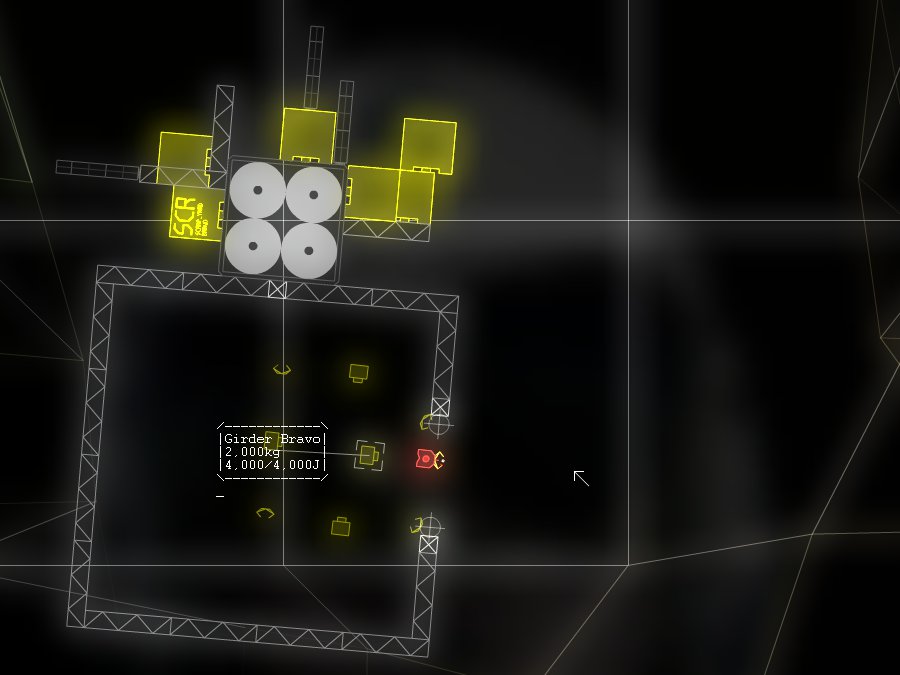
Scrap Yards didn’t change much when we left Earth. The chainlink and corrugated iron fences became girders, and business went on as usual. You can usually spot a pitbull terrier barking soundlessly at you from behind a habitation deck porthole.

You currently sell modules by dropping them somewhere near the station, but I’ll modify this soon to detect modules are in the scrap yard area. I’m excited about delivering modules by backing my ship up against the yard entrance, detaching a MkII booster from my vessel’s centerline aft, then unloading a huge bulk of girders and other spare parts to drift silently into the yard.

<3 Farbs


Station Field Guide Part IV – FAC

Factories are most easily recognized by their enormous manufacturing plant modules. These tend to be three times the width, height, and depth of the station’s standard module size. Other distinguishing features are the dry storage containers, and the cargo bay from which newly purchased items are launched.

I have some fun ideas for the scrapyard (SCR), but am still not sure what the upgrade (UPG) and repair (REP) stations should look like. Any ideas?

<3 Farbs